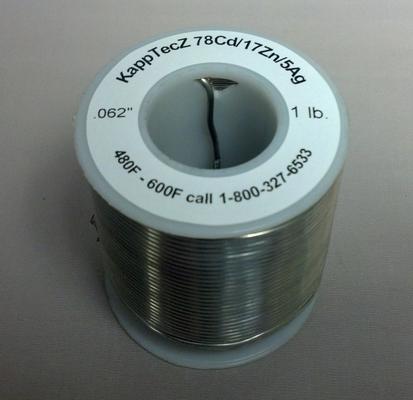
New Equipment | Solder Materials
KappTecZ is a high temperature, high strength solder that may be used on most metals, but works extremely well on aluminum, copper and stainless steel. It has a high tolerance to vibration and stress, and good elongation for use on dissimilar metals.
Electronics Forum | Wed May 09 17:13:06 EDT 2007 | zanolli
Re: 63/37 paste reflow Is there a standard reccomended time (ball park) above liquidus? What are the negative ramifications if the TAL is too short or too long? Thanks in advance
Electronics Forum | Mon May 28 09:37:02 EDT 2007 | davef
Look here: http://www.aimsolder.com/techarticles/Time%20Above%20Liquidus.pdf We have no relationship, nor receive benefit from the company referenced above.
Industry News | 2018-10-18 08:44:36.0
Lead-free Reflow Profile: Soaking type vs. Slumping type
Industry News | 2018-10-18 10:13:08.0
The Application of the Pin-in-Paste Reflow Process
Technical Library | 2023-01-17 17:27:13.0
Reflow profile has significant impact on solder joint performance because it influences wetting and microstructure of the solder joint. The degree of wetting, the microstructure (in particular the intermetallic layer), and the inherent strength of the solder all factor into the reliability of the solder joint. This paper presents experimental results on the effect of reflow profile on both 63%Sn 37%Pb (SnPb) and 96.5%Sn 3.0%Ag 0.5%Cu (SAC 305) solder joint shear force. Specifically, the effect of the reflow peak temperature and time above solder liquidus temperature are studied. Nine reflow profiles for SAC 305 and nine reflow profiles for SnPb have been developed with three levels of peak temperature (230 o C, 240 o C, and 250 o C for SAC 305; and 195 o C, 205 o C, and 215 o C for SnPb) and three levels of time above solder liquidus temperature (30 sec., 60 sec., and 90 sec.). The shear force data of four different sizes of chip resistors (1206, 0805, 0603, and 0402) are compared across the different profiles. The shear force of the resistors is measured at time 0 (right after assembly). The fracture surfaces have been studied using a scanning electron microscopy (SEM) with energy dispersive spectroscopy (EDS)
Technical Library | 2007-12-20 16:28:08.0
Despite much research and discussion on the subject of reflow profiling, many questions and a good deal of confusion still exist. What is clear is that the pains often associated with profiling can be reduced if there is a strong understanding of the variables that can be encountered during the reflow process, as well as the metallurgical dynamics of the soldering process. This paper shall provide a brief outline of the reflow profile in general, with specific emphasis placed upon the suggested time spent above the melting temperature of the solder. The guidelines for soldering to various surfaces and with alternative solder alloys also are discussed.
Events Calendar | Thu Oct 03 00:00:00 EDT 2019 - Thu Oct 03 00:00:00 EDT 2019 | ,
IPC Tech Ed Webinar Series: Ball Grid Array (BGA) and Bottom Termination Component (BTC) Design and Assembly Challenges: Reflow Profiling to Achieve Low Defect Rates and Successful Assembly! – Part 2
Reflow Profiling: Time Above Liquidus Reflow Profiling: Time Above Liquidus Despite much research and discussion on the subject of reflow profiling, many questions and a good deal of confusion still exist. What is clear is that the pains often
Heller Industries Inc. | https://hellerindustries.com/wp-content/uploads/2018/07/pan_APEX06.pdf
) solder joint shear force. Specifically, the effect of the reflow peak temperature and time above solder liquidus temperature are studied
ASYMTEK Products | Nordson Electronics Solutions | https://www.nordson.com/en/divisions/efd/resource-center/solder-selection-guide
C or more above the liquidus. If a solder joint needs to retain physical integrity during a later operation, such as a second reflow process, the peak temperature of the later operation needs to be below the solidus temperature of the alloy





winsouce.jpg)