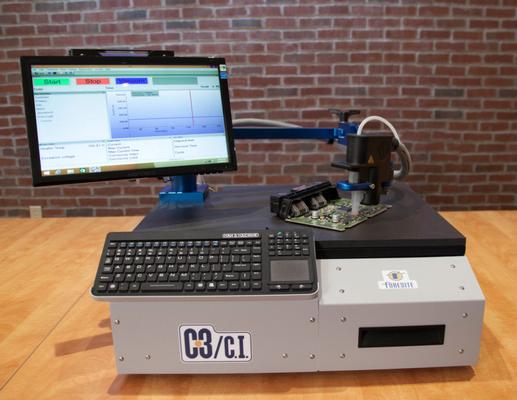
New Equipment | Test Equipment
Localized Electronics Cleanliness Tester and Residue Extractor The information gathered when using the C3 is intended to provide a measure of the cleanliness of a localized region of a circuit board. In addition, the C3 extracts a sample of the effl
Industry News | 2012-10-22 18:41:47.0
IPC and SMTA jointly announce the agenda for Session 3 of the High-Reliability Cleaning and Coating Conference, scheduled to take place November 13-15, 2012 at the Crowne Plaza Hotel – O’Hare in Chicago, IL.
Industry News | 2012-10-22 18:42:04.0
IPC and SMTA jointly announce the agenda for Session 3 of the High-Reliability Cleaning and Coating Conference, scheduled to take place November 13-15, 2012 at the Crowne Plaza Hotel – O’Hare in Chicago, IL.
Technical Library | 2016-09-08 16:27:49.0
In this investigation a test matrix was completed utilizing 900 electrodes (small circuit board with parallel copper traces on FR-4 with LPI soldermask at 6, 10 and 50 mil spacing): 12 ionic contaminants were applied in five concentrations to three different spaced electrodes with five replicas each (three different bare copper trace spacing / five replications of each with five levels of ionic concentration). The investigation was to assess the electrical response under controlled heat and humidity conditions of the known applied contamination to electrodes, using the IPC SIR (surface insulation resistance) J-STD 001 limits and determine at what level of contamination and spacing the ionic / organic residue has a failing effect on SIR.
Technical Library | 2023-04-17 21:17:59.0
The purpose of this paper is to evaluate and compare the effectiveness and sensitivity of different cleanliness verification tests for post soldered printed circuit board assemblies (PCBAs) to provide an understanding of current industry practice for ionic contamination detection limits. Design/methodology/approach – PCBAs were subjected to different flux residue cleaning dwell times and cleanliness levels were verified with resistivity of solvent extract, critical cleanliness control (C3) test, and ion chromatography analyses to provide results capable of differentiating different sensitivity levels for each test. Findings – This study provides an understanding of current industry practice for ionic contamination detection using verification tests with different detection sensitivity levels. Some of the available cleanliness monitoring systems, particularly at critical areas of circuitry that are prone to product failure and residue entrapment, may have been overlooked. Research limitations/implications – Only Sn/Pb, clean type flux residue was evaluated. Thus, the current study was not an all encompassing project that is representative of other chemistry-based flux residues. Practical implications – The paper provides a reference that can be used to determine the most suitable and effective verification test for the detection of ionic contamination on PCBAs. Originality/value – Flux residue-related problems have long existed in the industry. The findings presented in this paper give a basic understanding to PCBA manufacturers when they are trying to choose the most suitable and effective verification test for the detection of ionic contamination on their products. Hence, the negative impact of flux residue on the respective product's long-term reliability and performance can be minimized and monitored effectively.
Events Calendar | Mon Apr 12 18:30:00 UTC 2021 - Mon Apr 12 18:30:00 UTC 2021 | ,
Boston Chapter Webinar: Cleaning Chemistry For PWB and Rework - Part 2, session 1
Events Calendar | Mon Apr 12 18:30:00 UTC 2021 - Mon Apr 12 18:30:00 UTC 2021 | ,
Boston Chapter Webinar: Cleaning Chemistry For PWB and Rework - Part 2, session 2
SMTnet Express, Septemeber 8, 2016, Subscribers: 26,370, Companies: 14,943, Users: 41,052 How Clean is Clean Enough – At What Level Does Each of The Individual Contaminates Cause Leakage and Corrosion Failures in SIR? Terry Munson, Paco Solis



.gif)