Industry Directory | Manufacturer / Manufacturer's Representative
Sales/Marketing, Manufacturers Representatives, Used Equipment Sales
Industry Directory | Manufacturer's Representative
SMT assembly equipment including placement, reflow & vapor phase soldering, cleaning, X-Ray, AOI, SPI, conveyors. First Article Inspection (FAI). Consumables, splicing systems & tools, splice tape & clips. Understencil wiping Roll
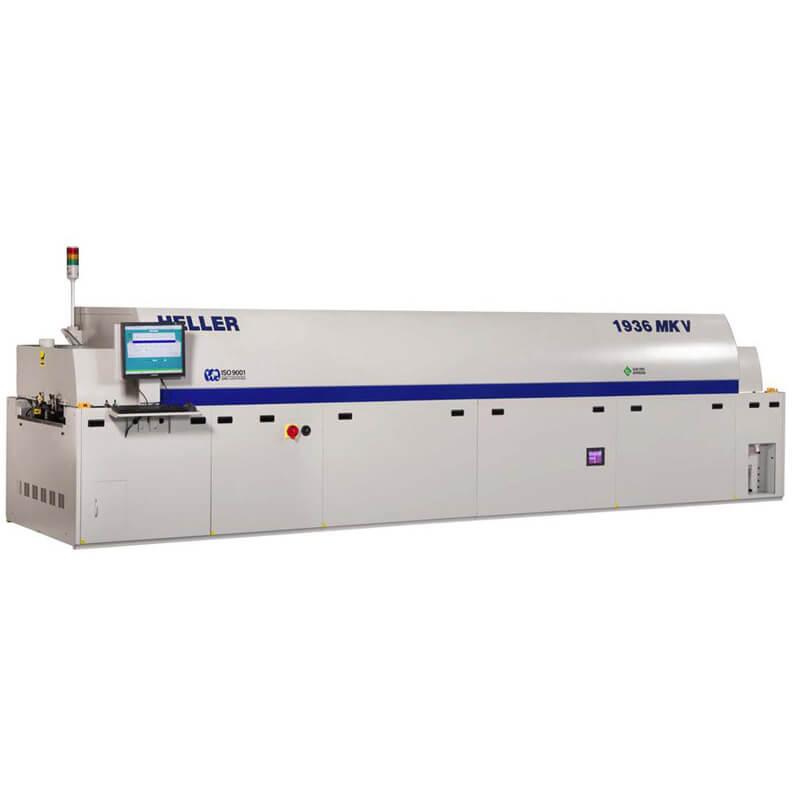
http://www.flason-smt.com/product/Heller-1936-MKV-Reflow-Oven.html Heller 1936 MKV Reflow Oven Reflow Oven SMT Reflow Oven Heller 1936 MKV Reflow Oven Heller 1936 MKV Product description: Heller 1936 MKV Reflow Oven - Formic Acid Horizontal
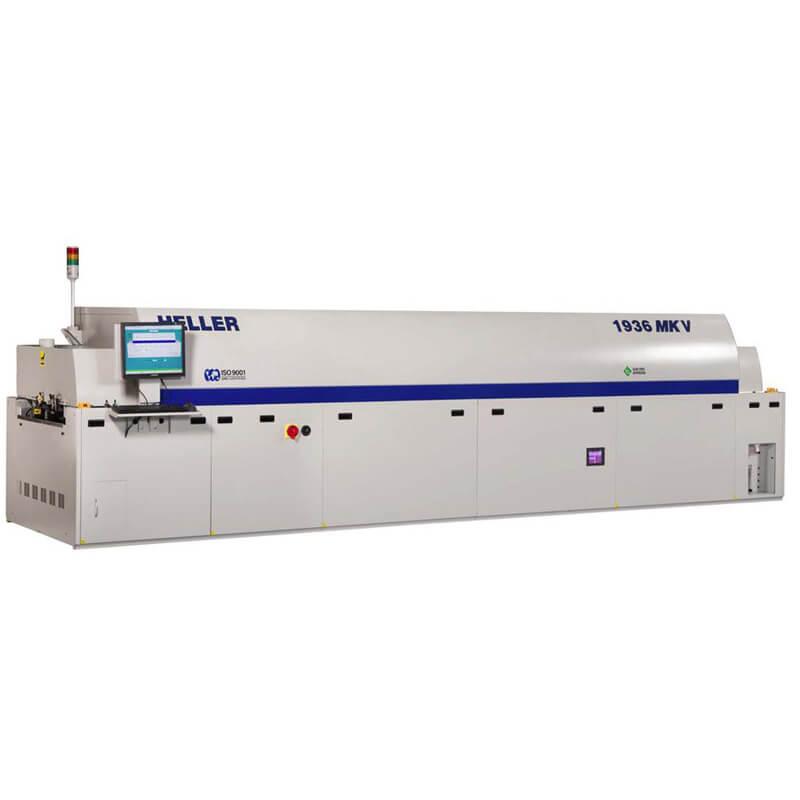
Flason SMT Heller 1936 MKV Reflow Oven Reflow Oven SMT Reflow Oven Heller 1936 MKV Reflow Oven Heller 1936 MKV Product description: Heller 1936 MKV Reflow Oven - Formic Acid Horizontal INQUIRY Heller 1936 MKV reflow oven&nbs
Industry News | 2009-03-12 18:25:36.0
The SMTA International Technical Committee invites you to submit an abstract for the 2009 conference. Short course descriptions are also being solicited.
Industry News | 2010-02-17 18:45:59.0
The SMTA International Technical Committee invites you to submit an abstract for the 2010 conference. Short course descriptions are also being solicited.
Technical Library | 2014-03-20 12:37:39.0
In the beginning of SMT, Vapor Phase Soldering was the preferred reflow soldering technology because of its excellent heat transfer capabilities. There were also some disadvantages like fast temperature rise, nearly no influence on the temperature profiles and high costs. So the use of Vapor Phase Soldering was reduced to special applications with high mass or complex boards in low numbers (e.g. for military or aerospace use).
Technical Library | 2020-09-23 21:37:25.0
The need to minimise thermal damage to components and laminates, to reduce warpage-induced defects to BGA packages, and to save energy, is driving the electronics industry towards lower process temperatures. For soldering processes the only way that temperatures can be substantially reduced is by using solders with lower melting points. Because of constraints of toxicity, cost and performance, the number of alloys that can be used for electronics assembly is limited and the best prospects appear to be those based around the eutectic in the Bi-Sn system, which has a melting point of about 139°C. Experience so far indicates that such Bi-Sn alloys do not have the mechanical properties and microstructural stability necessary to deliver the reliability required for the mounting of BGA packages. Options for improving mechanical properties with alloying additions that do not also push the process temperature back over 200°C are limited. An alternative approach that maintains a low process temperature is to form a hybrid joint with a conventional solder ball reflowed with a Bi-Sn alloy paste. During reflow there is mixing of the ball and paste alloys but it has been found that to achieve the best reliability a proportion of the ball alloy has to be retained in the joint, particular in the part of the joint that is subjected to maximum shear stress in service, which is usually the area near the component side. The challenge is then to find a reproducible method for controlling the fraction of the joint thickness that remains as the original solder ball alloy. Empirical evidence indicates that for a particular combination of ball and paste alloys and reflow temperature the extent to which the ball alloy is consumed by mixing with the paste alloy is dependent on the volume of paste deposited on the pad. If this promising method of achieving lower process temperatures is to be implemented in mass production without compromising reliability it would be necessary to have a method of ensuring the optimum proportion of ball alloy left in the joint after reflow can be consistently maintained. In this paper the author explains how the volume of low melting point alloy paste that delivers the optimum proportion of retained ball alloy for a particular reflow temperature can be determined by reference to the phase diagrams of the ball and paste alloys. The example presented is based on the equilibrium phase diagram of the binary Bi-Sn system but the method could be applied to any combination of ball and paste alloys for which at least a partial phase diagram is available or could be easily determined.
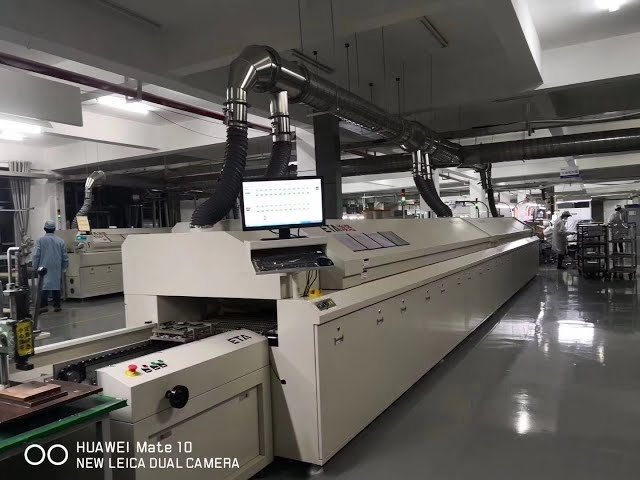
Radiator Reflow Soldering Oven for SMD Assembly Line ❙ Introduce of Reflow Oven ETA provide high reliability special reflow oven, SMD reflow soldering oven, radiator reflow oven, hot air reflow oven, for radiator production line. Speci
High Performance Customized Reflow Oven for Radiator ❙ Introduce of Reflow Oven ETA provide high reliability special reflow oven, SMD reflow soldering oven, radiator reflow oven, hot air reflow oven, for radiator production line. Spec
Events Calendar | Sun Apr 11 18:30:00 UTC 2021 - Sun Apr 11 18:30:00 UTC 2021 | ,
Europe Chapter Webinar: Tombstoning Components during Reflow Soldering - Causes & Cures
SMTnet Express, March 20, 2014, Subscribers: 22559, Members: Companies: 13833, Users: 35907 Today's Vapor Phase Soldering. An Optimized Reflow Technology for Lead Free Soldering. Dipl.-Ing. Helmut Leicht; Andreas Thumm; IBL-Löttechnik Gmb
Thermal Cycle Reliability Study of Vapor Phase BGA Solder Joints SMTnet Express September 13, 2012, Subscribers: 25475, Members: Companies: 8976, Users: 33645 Thermal Cycle Reliability Study of Vapor Phase BGA Solder Joints First published
KingFei SMT Tech | http://www.smtspare-parts.com/sale-9441243-automatic-solder-paste-mixer-smt-assembly-equipment-tin-cream-mixer-for-pcb-assembly.html
Automatic Solder Paste Mixer SMT Assembly Equipment Tin Cream Mixer For PCB Assembly Leave a Message We will call you back soon
Lewis & Clark | https://www.lewis-clark.com/product-tag/preowned-vapor-degreaser/
(33) SPI- Solder Paste Inspection Systems (7) Uncategorized (0) Wave Solder (6) X-Ray (3) New Products 2019 Vitronics Soltec Centurion CT820 Reflow Oven Call 603-594-4229 For Price Juki KE-2060L