
Industry Directory | Other / Consultant / Service Provider / Manufacturer
ScanCAD is an industry leader in inspection, measurement, process control and reverse engineering. Our solutions support OEM's, manufacturers, stencil fabricators, repair depots, and others in optimizing quality and yield.
Industry Directory | Manufacturer
Nepes offers flip chip solutions ranging from wafer bumping to advanced packaging and testing for IC manufactures, module electronics and end-product makers.
New Equipment | Rework & Repair Equipment
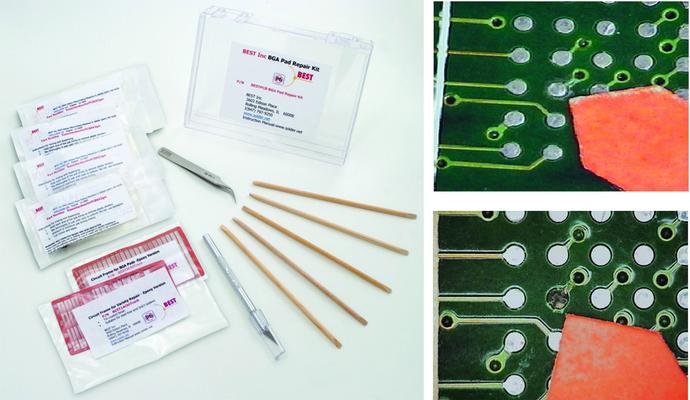
The BEST PCB pad repair repair kit gives you the tools you need for fast modification and repair of PCB circuit pads-no matter what their size. Our online PCB repair training videos, our master instructors along with these materials allows you to mee
New Equipment | Rework & Repair Equipment
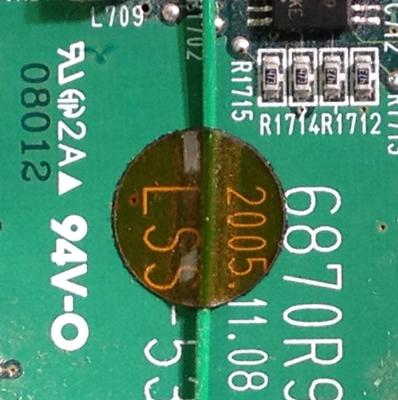
BEST HotDots™ are designed to simply and cleanly attach jumper wires on a board. HotDots™ are built to survive at high temperature as both the adhesive and the polyimide material are designed to withstand wash and reflow temperatures. HotDots™ are a
Used SMT Equipment | X-Ray Inspection
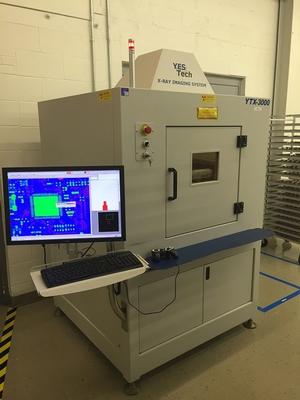
Yestech High Resolution Imaging PCB Xray Serial Number: X10706656 Model Number: YTX 3000 Year 2007-2008 130 KV XrayTube with 5 micron spot size Xray on Hours - 18.2 Standby Hours - 328.5 Measured Filament - 2.22 Hamamatsu L19181-02 Sam
Used SMT Equipment | X-Ray Inspection
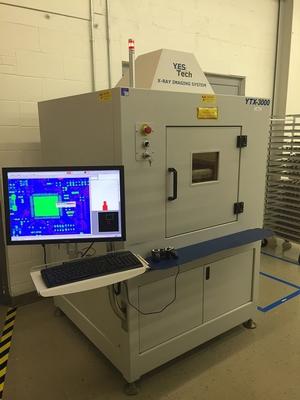
Yestech High Resolution Imaging PCB Xray Serial Number: X10706656 Model Number: YTX 3000 Year 2007-2008 130 KV XrayTube with 5 micron spot size Xray on Hours - 18.2 Standby Hours - 328.5 Measured Filament - 2.22 Hamamatsu L19181-02 Sample Ma
Industry News | 2009-10-17 09:43:47.0
Reduce PCB Repair Costs

 (4).jpg)
Technical Library | 2007-01-31 15:17:04.0
The goal of this project is to evaluate the reliability of lead-free BGA solder joints with a variety of different pad sizes using several different BGA rework methods. These methods included BGAs reworked with both flux only and solder paste attachment techniques and with or without the use of the BEST stay in place StencilQuick™. The daisy chained test boards were placed into a thermal test chamber and cycled between -25ºC to 125ºC over a 30 minute cycle with a 30 minute dwell on each end of the cycle. Each BGA on the board was wired and the continuity assessed during the 1000 cycles the test samples were in the chamber.
Technical Library | 2020-08-27 01:22:45.0
Initially adopted internal specifications for acceptance of printed circuit boards (PCBs) used for wire bonding was that there were no nodules or scratches allowed on the wirebond pads when inspected under 20X magnification. The nodules and scratches were not defined by measurable dimensions and were considered to be unacceptable if there was any sign of a visual blemish on wire-bondable features. Analysis of the yield at a PCB manufacturer monitored monthly for over two years indicated that the target yield could not be achieved, and the main reasons for yield loss were due to nodules and scratches on the wirebonding pads. The PCB manufacturer attempted to eliminate nodules and scratches. First, a light-scrubbing step was added after electroless copper plating to remove any co-deposited fine particles that acted as a seed for nodules at the time of copper plating. Then, the electrolytic copper plating tank was emptied, fully cleaned, and filtered to eliminate the possibility of co-deposited particles in the electroplating process. Both actions greatly reduced the density of the nodules but did not fully eliminate them. Even though there was only one nodule on any wire-bonding pad, the board was still considered a reject. To reduce scratches on wirebonding pads, the PCB manufacturer utilized foam trays after routing the boards so that they did not make direct contact with other boards. This action significantly reduced the scratches on wire-bonding pads, even though some isolated scratches still appeared from time to time, which caused the boards to be rejected. Even with these significant improvements, the target yield remained unachievable. Another approach was then taken to consider if wire bonding could be successfully performed over nodules and scratches and if there was a dimensional threshold where wire bonding could be successful. A gold ball bonding process called either stand-off-stitch bonding (SSB) or ball-stitch-on-ball bonding (BSOB) was used to determine the effects of nodules and scratches on wire bonds. The dimension of nodules, including height, and the size of scratches, including width, were measured before wire bonding. Wire bonding was then performed directly on various sizes of nodules and scratches on the bonding pad, and the evaluation of wire bonds was conducted using wire pull tests before and after reliability testing. Based on the results of the wire-bonding evaluation, the internal specification for nodules and scratches for wirebondable PCBs was modified to allow nodules and scratches with a certain height and a width limitation compared to initially adopted internal specifications of no nodules and no scratches. Such an approach resulted in improved yield at the PCB manufacturer.

PCB pad circuit repair using epoxy. Using multiple angles including overhead and from both right and left angles the BEST instructor staff demonstrates plainly how to repair a PCB pad using the epoxy method. This method is per IPC 7721 4.4.1. http://

This video is on the dry film pad repair technique per IPC 7721 standards. BEST professional instructors demonstrate the proper technique for the repair for PCB pads using the dry film. http://www.solder.net More on PCB pad repair here: http://www.s
Training Courses | | | IPC-7711/7721 Specialist (CIS)
The Certified IPC-7711/7721 Specialist (CIS) training focuses on rework of electronic assemblies and repair and modification of printed boards and electronic assemblies.
Training Courses | | | IPC-7711/7721 Trainer (CIT)
The Certified IPC-7711/7721 Trainer (CIT) courses recognize individuals as qualified trainers in the area of rework and repair of printed boards and electronic assemblies and prepares them to deliver Certified IPC-7711/7721 (CIS) training.
Career Center | Brooklyn, New York USA | Engineering,Production
Mini-Circuits designs, manufactures and distributes integrated circuits, modules, and sub-systems for high performance radio frequency (RF) and microwave applications. With design, sales and manufacturing locations in over 30 countries, Mini-Ci
Gold Wire Bonding Performance and Reliability of ENEPIG Surface Finishes Gold Wire Bonding Performance and Reliability of ENEPIG Surface Finishes The expression "multifunctional PCB", as a synonym for a PCB which is applicable with a variety
ASYMTEK Products | Nordson Electronics Solutions | https://www.nordson.com/en/industries/electrical?con=t&page=6
) instructions Assembly Using X-Wire™ Insulated Bonding Wire Technology Nordson MARCH Wearing a wire? Wearable electronics present exciting opportunities for human-technology interaction Nordson DAGE 5th March, 2021 Stellar 4000 datasheet Nordson DAGE First
GPD Global | https://www.gpd-global.com/pdf/lead-former/CF8-Wire-Clamp-Replacement-8201622.pdf
. Install horizontal or modified horizontal dies of any size in stations 6 & 7. 2. Place slid assembly (PN 801-1-200) in die block. 3. Inspect wire clamp-to-die alignment